


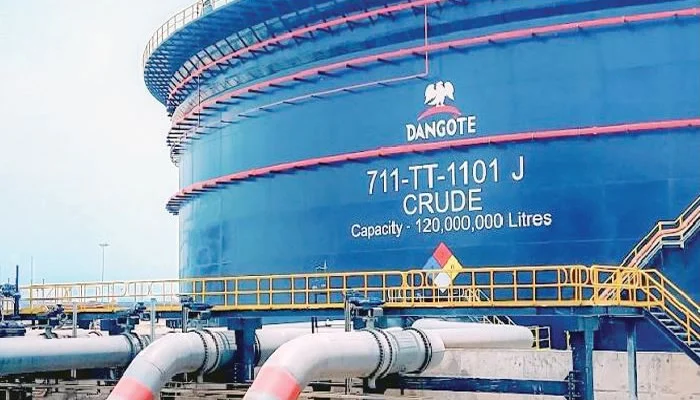
Dangote Refinery’s decision to price petrol sales in US dollars marks a significant shift in Nigeria’s downstream petroleum market. While the move may reduce foreign exchange risks for the refinery, it also ties domestic fuel pricing more closely to exchange-rate movements, raising fresh questions about inflation, the future of the naira-for-crude policy, and the cost of doing business in Africa’s largest economy.
Why This Story Suddenly Matters
Around the world, commodities are typically priced in US dollars because it provides a common benchmark for international trade. Yet governments often seek ways to reduce dependence on the dollar to strengthen local currencies and improve economic stability. Nigeria’s experiment with supplying crude oil to local refiners in naira was designed to achieve exactly that objective. Dangote Refinery’s latest commercial shift therefore represents more than a pricing adjustment—it highlights the tension between market realities and public policy.
The decision comes at a time when exchange-rate volatility, elevated financing costs and fluctuating crude oil prices continue to reshape energy markets. For investors and businesses, the development reinforces a familiar lesson: currency risk has become as important as oil prices in determining profitability.
What Is Really Driving This Development?
The underlying issue is not simply the choice of currency but the economics of operating a refinery. When crude oil, spare parts, financing and many operational costs are linked to the US dollar, selling refined products in naira exposes the business to exchange-rate losses. Moving to dollar pricing aligns revenues with costs and reduces uncertainty in financial planning.
The broader implication is that Nigeria’s downstream market remains influenced by global financial conditions despite having one of the world’s largest single-train refineries. Domestic refining reduces dependence on imported fuel, but it does not automatically insulate the economy from foreign exchange pressures if major transactions remain dollar-based.
What This Means for Nigeria
For Nigerian consumers, the immediate concern is that petrol prices could become more sensitive to movements in the naira. If the local currency weakens, marketers’ costs may rise, increasing pressure on pump prices and, ultimately, transport fares and food inflation.
For government, the development raises important policy questions about the effectiveness of the naira-for-crude initiative and whether sufficient domestic crude supply can be sustained to reduce reliance on dollar-denominated transactions. Businesses that rely heavily on transportation and logistics may also face greater cost uncertainty, potentially feeding into broader inflationary pressures.
The Question Nobody Is Asking
The real issue is not whether Dangote Refinery should sell fuel in dollars. The more important question is why Africa’s largest oil producer still finds it difficult to build a petroleum value chain that operates predominantly in its own currency. If domestic refining cannot meaningfully reduce exposure to exchange-rate volatility, then Nigeria’s energy security strategy may require deeper reforms beyond refinery capacity alone.
Angle 360 Analysis
Dangote Refinery’s pricing decision should be viewed as a market signal rather than an isolated corporate action. It reflects the continued dominance of the US dollar in global commodity markets and underscores the structural weaknesses of Nigeria’s foreign exchange ecosystem. The long-term solution lies not in administrative pricing directives but in improving crude supply arrangements, strengthening foreign exchange liquidity and building confidence in the naira. Until those foundations improve, businesses across the energy value chain are likely to continue managing their risks through dollar-linked pricing.
Angle 360 Verdict
This development is less about fuel and more about confidence. It illustrates that exchange-rate stability has become one of Nigeria’s most valuable economic assets. Unless policymakers can create conditions where businesses are comfortable pricing major transactions in naira, the country’s ambition to reduce dollar dependence will remain difficult to achieve. The refinery’s decision is therefore a reminder that currency stability is no longer just a monetary policy objective—it has become a decisive factor in Nigeria’s competitiveness, inflation outlook and long-term economic resilience.
